Drugreporter February 18, 2026: Who am I to tell you not to use drugs? By Istvan Gabor Takacks.
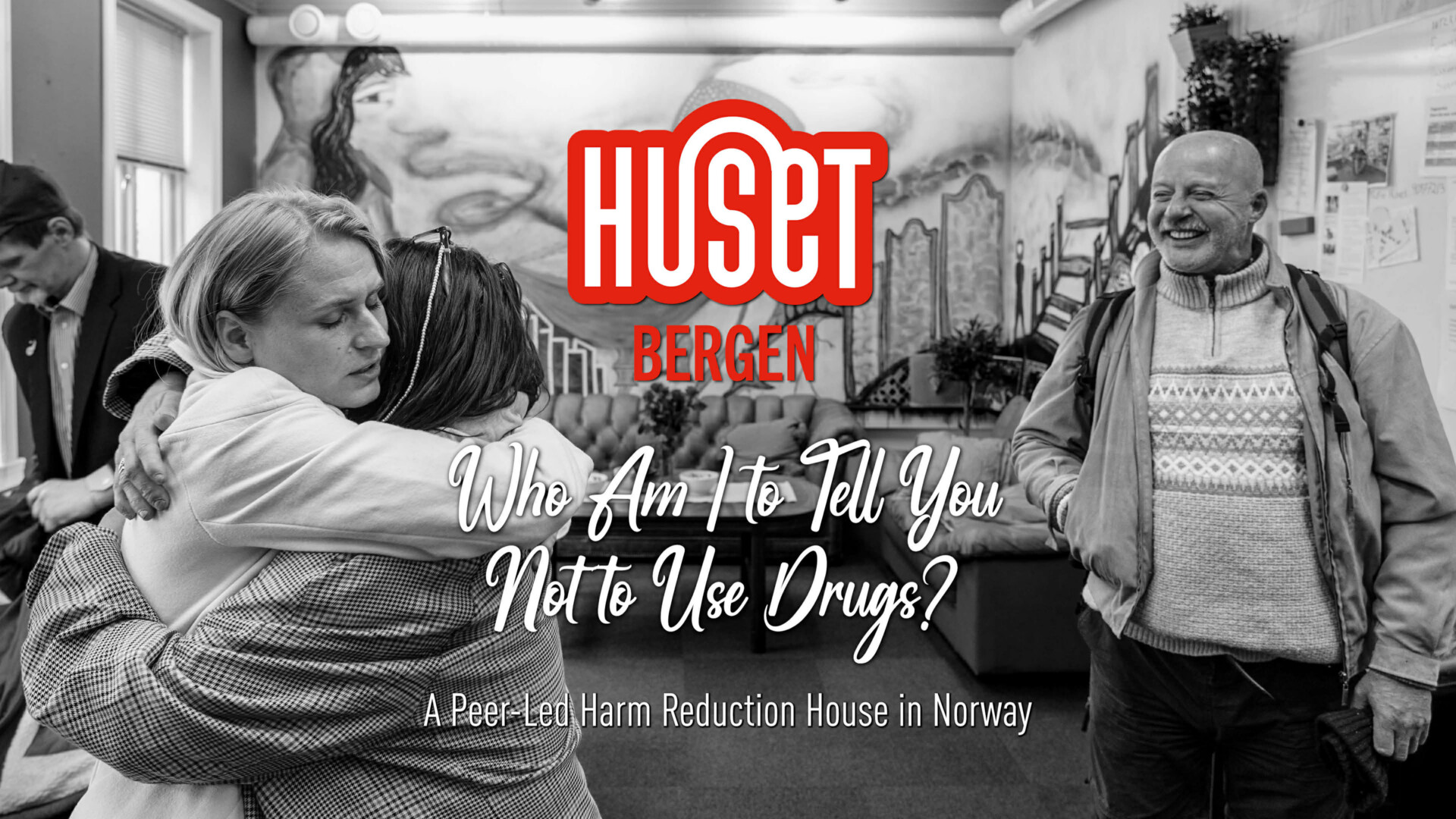
In Bergen, on Norway’s rainy western coast, Huset Bergen — a three-storey harm reduction centre — is run entirely by people with lived and living experience of drug use. Drugreporter joined Arild Knutsen from the Association for Humane Drug Policy to explore this bold model and found something striking: not resistance, but broad community support — from neighbours to bankers and politicians. Watch our new documentary on the future of peer-led drug services.
A House Founded by People Who Use Drugs
The House — “Huset Bergen” in Norwegian — was founded in 2022 by three organisations of people who use drugs: A-Larm, proLAR Nett and the Association for Humane Drug Policy. Its aim is simple but ambitious: to create a safe space for belonging and practical support for people who use drugs, many of whom experience homelessness or extremely precarious living conditions.
‘It means everything to me. It’s a meeting place, It’s a safe haven. It’s a place to get information, a place to get help. It’s a place to get clothes. It’s a place to get food.’
Tom Andre Faye, a Peer-to-Peer Bridgebuilder employed at the House, tells us this in a small office upstairs.
Peers provide needle and syringe exchange, safe disposal of used equipment — including small round “puck” containers — and naloxone training. They conduct outreach on the streets of Bergen, connect people to housing and healthcare, and provide immediate, practical support grounded in trust.
Ownership Instead of Control
Huset is fully operated by people with lived and living experience. As Marianne Pierron, co-founder and director of the House, explains:
‘We got the same salary. And I think that this makes me no more important than the person who cleans the floor or is making the food or is drifting this place. And we are successful because they are owners of the house. It’s their house.’
That sense of ownership shapes the atmosphere. There are no searches, no punishment, no moralising. Yet precisely because the House belongs to its users, they themselves intervene if someone attempts to deal drugs on the premises or disrupt the space. Responsibility replaces enforcement.
From Harm Reduction to Social Participation
One of Huset’s most important contributions is shortening the path to active social participation. Lisbeth Haugland had not been employed for 30 years before receiving an opportunity to work at Huset. Today she supports visitors facing a wide range of challenges.
‘It’s a delicious experience to look at somebody that, you have seen before to just sit like this’ she says, shoulders lowered. ‘And now they’re like this!’ She gestures upward like a rocket taking off.
The municipality also funds Huset to operate a night shelter, open every night from 22:00 to 09:00. Like the House itself, it is fully staffed by people with lived and living experience.
When we visited to film, we were welcomed with a generous serving of vegetable omelette, prepared by Yngvar Kristoffersen, who cooks around 100 meals daily for an average of 150 visitors. Before beginning work each day, he first visits HABIB, a heroin-assisted treatment clinic just a few blocks away.
‘The success is the medication. It’s the diamorphine.’ explains Vibeke Buljovcic, director of the state-run pilot project providing legal heroin to people who have not benefited from other treatment options. ‘They’re functioning well. Absolutely functioning well.’ [They get] better quality of life. Definitely… And we try to not just give the heroin, but also take care of the rest of the person.’
For Yngvar, this stability matters.
‘Running the kitchen is very OK for me. As long as people are happy, I’m happy. And they are mostly happy.’
City and Business Support for Huset Bergen
What is perhaps most remarkable is the level of institutional support Huset receives. In many countries, such initiatives face opposition. In Bergen, they are publicly praised.
At the “Everyone Can Do a Little” Conference, senior city officials highlighted Huset as a success story.
‘They have not been given a place in the city, they have taken it. They have taken that place by being visible, by actually cooperating both with the municipality, with business and with others. And it is such a great joy to see how it has been received in our city.’
said Marit Warncke, Mayor of Bergen (2023–2027), from the Conservative Party of Norway.
Charlotte Spurkeland, Commissioner for Child Welfare, Social Services and Diversity, also from the Conservative Party, explained:
‘I think we’ve seen in Norway that the way we’ve been handling drug issues hasn’t been working. There’s been a big national debate about the policy, and there have been some changes, which is good, which is more like, giving help instead of punishment. I think we see that we can’t solve these problems on our own and that we need to work together. And so far, it’s really working.’
Business leaders echo that sentiment.
‘What Marianne did and what the House in Bergen did, was to change the whole idea that we can’t have people coming together. Yes, we can, if we have an opportunity to get a nice meal to meet other people, who care. And I think the whole city saw that.’
said Frode Fjellstad, Director of Grant Allocations at Agenda Vestlandet.
The Bergen Chamber of Commerce supported the conference, the House and this film. Sverre Simen Hov, Policy Advisor at the Chamber, described why:
‘We need to trust in each other. We need to be able to speak to each other. It makes common economic sense. It also makes less of a burden on budgets for the municipality here. [Huset Bergen] gives so much back to the Bergen society, and it gives a lot of credibility back to the companies. So it’s on every level, but most importantly, on the human individual level, it makes so much sense to engage in this.’
According to Christian Ohldieck, Director of the Department of Addiction Medicine at Bergen University Hospital, the peers at Huset provide valuable insight into service development:
‘There’s a huge potential in this collaboration. The importance of the drug user perspective in how we develop our services and how we treat our patients is very important.’
Fighting Dehumanisation and Breaking Stigma
Huset’s mission extends beyond service provision.
‘I hope we can start to bring a change of how people look at drug addicts and, the rehabilitation of drug addicts. I hope we can show that people who use drugs can do a full day’s job.’
said Tom Andre Faye.
‘And take down those walls. And stigma, you know?’ added co-founder Herman August Steffensen.
The House also documents its own reality. After three decades as a war photographer, Morten Emil Hvaal found a different kind of peace here.
‘People are letting me get closer and closer.’ he explains. ‘But I’ve also always made sure they know that I am not interested in the photographs when they look like the stereotypical image that you see in the media… because there isn’t one.’
His words resonate with our own approach at Drugreporter:
‘The sort of essence of proper documentary making, is that you’re not necessarily or you’re not at all after the extremes. You’re after what is representative… Society doesn’t know anything about them, largely because society doesn’t want to know. It’s uncomfortable. And ignorance is the enemy of all kinds of interaction and all kinds of societies.’
In the end, the work is about humanisation — restoring the dignity that stigma and marginalisation take away.
As Marianne Pierron told us:
‘I don’t like people – I don’t care who they are – to be dehumanized. So that is what’s keeping me running. And as long as you see people as people, eye to eye, heart to heart, gut to gut, we can do this changing together.’
Interviews: Arild Knutsen
Article, camera, directing and editing: István Gábor Takács