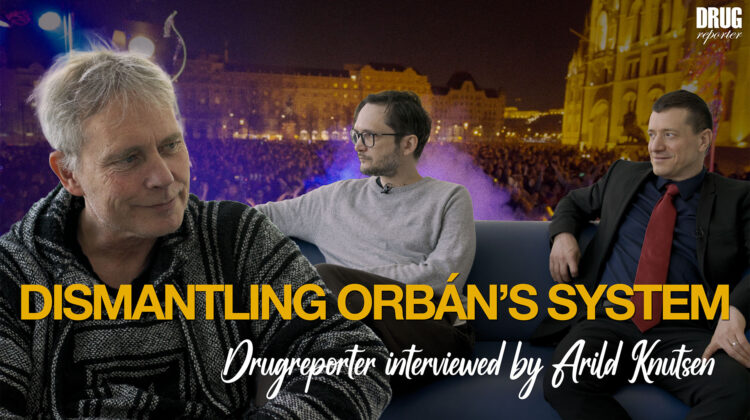
Drugreporter April, 10. 2026: Dismantling Orbán’s System – Drugreporter interviewed by Arild Knutsen
As Hungary heads toward a pivotal election, the camera turns on two of its most prominent drug policy advocates. In this interview conducted by Arild Knutsen, Drugreporter founders Péter Sárosi and István Gábor Takács reflect on decades of activism—and explain why they are now taking their fight to the streets to challenge an increasingly repressive system.
For more than twenty years, Péter Sárosi and István Gábor Takács have been the eyes and the ears of the global drug policy movement. Through their video activism with Drugreporter and the Rights Reporter Foundation, they have documented every major milestone and interviewed the most influential figures in the field. They have been our open door to the world of drug policy reform. They also train others in working for political influence and video activism.
With the upcoming election in Hungary, it was time to turn the camera around. At this year’s CND in Vienna, I sat down with them to talk about their story and the critical situation in their home country. As Hungary approaches the pivotal election, the political climate has grown increasingly tense. The Hungarian government is very close to Putin, the dictator of Russia, and they are importing some of the policies of Russia.
In February last year, the Prime Minister, Viktor Orbán, launched a so-called war on drugs in Hungary. This resulted in a lot of young people who use drugs being arrested. They also wrote into the constitution that it is illegal to use, possess, and «promote» drugs—something that implies that the drug policy and harm reduction movement might be stormed and closed.
They started to raid music clubs. They used humiliating search-infringing measures, and they sometimes exposed the arrested young people to such risks that they had reason to fear for their lives.
In response, Péter Sárosi and István Gábor Takács have moved from behind the lens to the front lines. They are the initiators behind a series of “dance protests” that have seen thousands of Hungarians occupy the streets of Budapest. By using the rhythmic energy of electronic music as a political tool, they have created a platform for a generation that refuses to be silenced.
For them, this is a strategic move to reoccupy public and civic spaces that the government has attempted to marginalize—and to dismantle the humiliating system that is destroying lives.
Péter Sárosi explained why they organized protests in front of the Hungarian parliament:
“If the government wants to push the dance culture outside to the margins, then we will bring it to the centre. If they want to occupy our spaces, then we will reoccupy the public and civic spaces. Dancing is about the autonomy of the person and bodily autonomy. It’s a kind of embodied form of self-expression. And it’s a very adequate way to protest, because when they are banning dance clubs, we go out to dance.”
When I asked what keeps them motivated, István Gábor Takács replied:
“I always feel here at the UN as if we were in medieval times, talking about the best practices of burning witches—like listening to a presentation in the plenary room about the evidence-based best type of wood for burning. I am very sensitive to injustice, and to people being hurt. In this field, that’s what you see all the time. If we can mitigate the harm and reduce this kind of suffering—not necessarily caused by drugs, but by people against each other—if we can contribute to that, then that’s a huge thing for me.”
Peter added: “In Hungary the government calls us drug liberalisers, which is not true, we want regulation. We have to provide access to people but with strict control. We are accused of only advocating for the rights of a small minority, but the current prohibition policy is bad for the whole society, not just for people who use drugs. This is a misunderstanding that we have to correct.”
“When they are hurting people for taking one kind of drug, while rewarding and patting people on their back for taking the other, it’s completely insane.” Said István. ”That always keeps us motivated to do something about. We want a drug policy that’s centered on human rights and dignity. One that is about love, and human connection. Which brings us together instead of being against each other.”
Interview and text: Arild Knutsen, Director, Association for Humane Drug Policy (FHR), Norway.
Video: István Gábor Takács, Drugreporter.